Kennecott Lacks State, Federal Permits to Proceed With Mine Plan

Kennecott Minerals Co. currently lacks all major state and federal permits required in order to open and operate its proposed Eagle Project metallic sulfide mine on the Yellow Dog Plains, in Marquette County.

Recently, the company purchased the site of the old Humboldt Mill, in Humboldt Township, that was used to crush ore from Callahan Mining Company’s Ropes Gold Mine decades ago.

Although Kennecott has yet to submit a permit for its processing complex, Eagle Project manager, Jon Cherry, claimed, at an October 6 meeting, that the mill will be operational by 2010.

Local Save the Wild UP Director, Kristi Mills, said “For Kennecott to announce that it is moving forward with its Eagle Project and Humboldt mill plan is grossly pre-mature when you consider the big picture. They have neither the legal permits nor public consent to boast their achievements.”

According to Department of Environmental Quality (DEQ) deputy director Jim Sygo, at Humboldt, “There are Waters of the State issues, and the site is a facility under [Part 632, the new metallic mining law], which will generate significant issues to permit this site.”

In a July, 2008 letter, Sygo acknowledged “that the reopening of the Humboldt processing facility would require a separate permit.”

Sygo also acknowledged that Kennecott “would have to apply for an amendment of the Mining Permit for construction of a new haul road and would likely need permits under Part 301, Inland Lakes and Streams and Part 303, Wetlands Protection…as well.”

Regarding the company’s plans to power the mine, Sygo said that Kennecott “would have to apply for an amendment to its Part 632 Mining Permit before beginning activities to extend electrical service from CR 550 to the Eagle Project mine site.”

A mining permit for the Humboldt facility will require State review of Kennecott’s application and public hearings before approval would be considered.  Construction of their own haul road and extension of electric utilities will require Kennecott to amend its Mining Permit, effectively restarting the permitting process with public hearings and another DEQ decision.

To further complicate its plans, Kennecott lacks a required underground injection permit from the US Environmental Protection Agency (EPA).

The US Fish and Wildlife Service (USFWS) has also requested that the EPA conduct studies relating to the endangered Kirtland’s warbler and the threatened Canada lynx before issuing a decision on Kennecott’s federal permit.  The USFWS has suggested that potential mining affects to the native Coaster Brook Trout could also complicate Kennecott’s application process. The USFWS will issue a 12 month finding on the petition on December.
Author Eric Hansen to give Presentation on Sulfide Mining in Wisconsin

Stand By Your Land

Award-Winning Author, Noted Hiker Eric Hansen Will Present the Keynote Address for the Wisconsin Sierra Club Autumn Assembly on October 11 in Wisconsin Dells
His Theme Will Be:

Stand By Your Land:
Wisconsin and the U.P.; The Powerful Storylines of Our Iconic Landscapes and the Citizens Campaigns That Have Defended Them

Continue reading

Public Meeting: Michigan Great Lakes Restoration and Protection Initiative

LANSING, MI (September 30, 2008) – The Superior Watershed Partnership in cooperation with Northern Initiatives and Lt. Gov. John Cherry today announced that a public input meeting will be held in Marquette on October 13, 2008 at 7pm in the Great Lakes rooms of the University Center on the campus of Northern Michigan University.  This meeting is being held to gather local regional input for Michigan’s Great Lakes Restoration and Protection Initiative.  In June of this year, Lt. Governor Cherry joined the Michigan Office of the Great Lakes and Michigan United Conservation Clubs (MUCC) to announce the Initiative in Lansing which has since led watershed alliances, sportsmen’s organizations, tribal entities and other non-governmental and governmental stakeholders to participate in developing a framework for a comprehensive restoration and protection plan for Michigan.  Part of the framework involves gathering regional priorities for the plan.

The Superior Watershed Partnership’s Executive Director, Carl Lindquist said that the October 13 meeting is crucial for the region’s involvement in Great Lakes issues.  “The Watershed Partnership is pleased to help sponsor this event that gives residents of the Upper Peninsula a more active role in prioritizing Great Lakes issues and opportunities in Michigan” said Lindquist.  “Upper Peninsula concerns are not always the same as Lower Michigan. This is especially true regarding the Great Lakes. This meeting is a great opportunity to influence a new state-wide strategy for Great Lakes restoration”.

Northern Initiatives President, Dennis West, emphasized the important role that the Great Lakes play in the Upper Peninsula economy.  According to Mr. West, “a framework for protecting and restoring the Great Lakes is a perfect opportunity to use a Triple Bottom Line lens.  The interplay between the economy, the environment and the aspirations’ of people is an important contribution to a framing dialogue”.

The Superior Watershed Partnership and Northern Initiatives have worked with MUCC and the Office of the Great Lakes to sponsor the event and ensure that a wide variety of local stakeholders will show up to contribute their concerns and priorities for regional restoration and protection.  The meeting will take place in the Great Lakes rooms of the University Center on the campus of Northern Michigan University at 7:00 p.m. on October 13, 2008. For questions please contact the Superior Watershed Partnership at 906-228-6095 or Northern Initiatives at: 228-5571.

Discussion questions for outreach meetings

Australia: Iron Ore Workers Vote to Walk off Job at Rio Tinto Mine

Pilbara mining workers to strike over claims

    Paige Taylor and Ewin Hannan | October 07, 2008

    STRIKE action will interrupt Rio Tinto’s Pilbara operations for the first time in 16 years, as Australian Workplace Agreements expire and locomotive drivers earning up to $210,000 a year engage their union in a push for collective agreements.

    Train drivers who are members of the Construction Forestry Mining and Energy Union and employed by Pilbara Iron Ore and Hamersley Iron Ore voted late last night to walk off the job for 12 hours on Saturday, and have voted in favour of continued strikes of four, 12 or 24 hours in pursuit of their claims.

    Sulfide Mining Introduced as a Major Threat to the Great Lakes

    Panel Discusses Great Lakes Basin Compact

    Sulfide Mining Introduced as a Major Threat to the Great Lakes

    October 3, 2008

    Marquette, MI – Three panelists addressed environmental and conservation issues threatening the Great Lakes at a symposium sponsored by Northern Michigan University’s Political Science department. Panelists also presented a general outline of the new “Great Lakes Basin Compact,” which has been signed by the Governors of eight US states, as well as Ontario and Quebec.

    In a presentation on the Great Lakes basin, Tom Baldini, current Upper Peninsula aide to US Representative Bart Stupak, noted that Lake Superior takes 190 years to regenerate its water supply, leading to concerns with long-term pollution. Baldini explained that, because Lake Superior has such a large surface area, it acts as a “cup” that collects and retains air pollution from as far away as China.

    Ken Sikkema, former Michigan Senate Majority Leader and current Senior Policy Consultant with think-tank Public Sector Consultants (president and CEO, William Rustem, is a Kennecott consultant), maintained that “eternal vigilance is the price of protecting the Great Lakes” and considered invasive species the greatest threat to the Great Lakes.

    Journalist, author and former environmental advisor to Governor James Blanchard, Dave Dempsey, urged the audience to consider, not only today’s economy, but our economy 30 or 40 years from now. Addressing the potential for long-term damage from acid mine drainage into the Great Lakes, Dempsey said, “I don’t see sulfide mining and the potential for long-term damage to Lake Superior…which….has a retention time of 190 years, as a very wise economic choice for the State. The benefits are few and the risks are great.”

    Dempsey introduced inconsistencies with previous Great Lakes protection measures. Under a federal statute, Governors in states within the Great Lakes basin were able to veto any plan that diverts water outside of the Great Lakes basin. In 2001, Governor John Engler “vetoed” such a plan by a community in New York State to sell water commercially. However, only several months later, Perrier (now owned by Nestle) received permission from Engler to bottle water, in Michigan, for sale outside the Great Lakes basin.

    In another example, Dempsey said that, despite campaign promises that she would prevent diversion and export of Great Lakes water, in 2003, Governor Jennifer Granholm intervened against Michigan citizens to overturn a court decision preventing Nestle from extracting Michigan water for sale throughout the world.

    A major concern with the new Compact is the potential commodification of water. Dempsey noted that free trade agreements consider it illegal to prevent the export of a product across international boundaries.

    According to Dempsey, “The danger that I see in the Great Lakes Compact, which became law today, is that we have now ratified a statutory policy of the eight Great Lakes states and the federal government that that water can be a product and not just a publicly-owned resource.”

    Attendees were left with Dempsey’s hopeful message that, while “the damage may be done; on the other hand, there’s always the opportunity for us to go back to the Michigan legislature and, hopefully, Congress and strengthen the policies and try to prevent the commercialization of water.”

    Several audience comments and questions concerned the threat of metallic sulfide and uranium mining to the Great Lakes. Some comments concerned the ability of legislation to protect the Great Lakes when continued industrial pollution would be permitted to continue. Panelists raised questions as to whether or not the State of Michigan has enough funding, or the will, to properly regulate and control continued industrial pollution.

    According to Baldini, “We have laws…how will they be enforced…how will they be measured.”

    Dempsey express that he does not “have faith that the State is prepared or willing or able to enforce that law….Funding for the Department of Environmental Quality is at an historic low level. The Director recently said, talking about a wetlands program, we don’t have enough staff to even send out to check on the permits anymore…basically, he said, we have an honor system…I have no faith that the Department of Environmental Quality will do the job.”

    Beaver Basin Action Alert

    ACTION ALERT

    BEAVER BASIN WILDERNESS PROPOSAL AT PICTURED ROCKS NATIONAL LAKESHORE IN FINAL PHASE

    By the end of this legislative session in late October it is expected that the Senate will approve an omnibus lands bill that includes federal wilderness designation for the Beaver Basin at Pictured Rocks National Lakeshore. It has passed through all the necessary hoops so far, but its biggest hoop may well be in the House, where it will be immediately referred upon Senate passage. It needs to go through the House without dissent or calls for revision.

    Representative Bart Stupak is the key member of our Michigan House delegation. Pictured Rocks lies within his congressional district. He holds the fate of this legislation in his hands. He has said “I do not support this bill at this time.” It is widely assumed that means “before the election.” We need to get him to change his mind and allow the Senate version of this omnibus lands bill to pass through the House without dissent.

    Here are arguments to use in your phone, email, and snail mail messages to Representative Stupak:

    • The 2004 Management Plan for the national lakeshore made all the essential compromises that Representative Stupak pushed for. It represents a community consensus on the main issues. It reduced the size of the wilderness area, it allowed motorized boats on the Beaver Basin lakes (albeit electric motors), it kept the Beaver Basin campground outside the wilderness, and allowed boats to land on the Lake Superior shoreline within the wilderness.

    • There has been no active opposition among locals in Alger County where the Pictured Rocks National Lakeshore is located. Wilderness designation no longer seems to be a red flag.

    • The Marquette Mining Journal gave the wilderness designation a positive editorial.

    • Public access will not be changed, as this remote middle portion of the lakeshore has long been managed as primitive, non-motorized backcountry, and will continue to be so managed under wilderness designation.

    • The national lakeshore is a valuable asset for Alger County. With the 2004 Plan’s improvements in developed visitor facilities on the east and west ends of the lakeshore, and the resumption of paving on H-58 along the lakeshore’s boundary, its economic value to the region is only being further enhanced.

    Save The Wild UP’s Bi-Monthly Publication

    The Splash

    We have a new title for our publication! It’s now called The Splash and we hope it will help our grassroots efforts and make waves about metallic sulfide and uranium mining throughout the Great Lakes Region.

    WHAT IS THE SPLASH: The  latest news about metallic sulfide mining and environmental issues from across the UP, Michigan, and the Great Lakes Region.

    WHERE CAN YOU GET YOUR VERY OWN COPY?: Our publication is inserted into the Marquette Monthly and distributed to local businesses throughout Marquette. You can also pick up a copy at our office.

    WHEN CAN YOU GET ANOTHER ONE?: We publish The Splash bi-monthly.

    WHY: We have decided to become our own media in order to communicate issues to the public that we believe are important.  We feel it is of the utmost importance to educate the public about environmental issues that could affect our way of life.

    Give our office a call if you need extra copies for your friends 906.228.4444

    Minnesota: dispute intensifies over sulfide mining

    Political dispute intensifies over potential pollution from copper-nickel mining

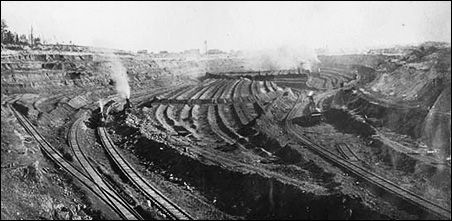
    Biwabik Mine

    Courtesy of the Minnesota Historical Society. A mine near Biwabik, circa 1900.

    By Ron Way | Monday, Oct. 6, 2008

    As the date nears for a long-anticipated release of perhaps the most important environmental document in Minnesota’s mining history, political wrangling has stepped up over concerns about the effects of copper-nickel mining on ground and surface water in a region world famous for the quality of its forested lakes and streams.

    Continue reading

    Hike, Draw, & Dance with the Yellow Dog Watershed Preserve

    Enjoy Three Upcoming Events Hosted by the Yellow Dog Watershed Preserve


    October 4, 2008: Hike to the McCormick Tract- We are celebrating the 40th anniversary of the National Wild and Scenic Rivers Act by hiking to the segment of the Yellow Dog River that is federally protected by this legislation. Everyone interested should meet at Cram’s General Store in Big Bay to carpool at 10am. Bring a lunch, water, and the necessities for a good hike. Call 906-345-9223 if you have questions.

    October 5, 2008: Naturalist Drawing Workshop-Join YDWP and art enthusiast Nancy Moran to capture nature’s beauty. We will take a short hike to a picturesque spot and draw/paint as a group with Nancy lending her expertise. This event is free but you must bring your own supplies. Everyone interested should meet at the Yellow Dog Watershed Preserve office in Big Bay at 1pm. Call 906-345-9223 for more details.

    October 18, 2008:
    Benefit Concert for the Yellow Dog Watershed Preserve- Numerous musical acts will be entertaining the guests including local favorite Mike Waite. Doors open at 5pm and music begins at 5:30pm. Tickets are available at the door for $7 per person or $15 per family. All proceeds will go to YDWP. The concert will be held at the Peter White Public Library. The poster is attached if anyone wishes to print one or to view it. This will be a fun night so make plans to attend! Call 906-345-9223 if you have questions.