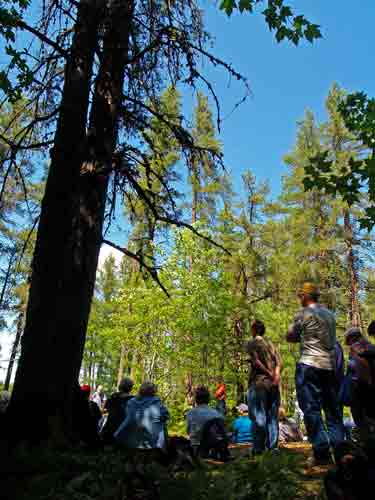
Ceremonial Long Walk of the Drum – Eagle Rock – Yellow Dog Plains – July 17, 2011 – Sunday – 12:00 Noon

“This was a dream . . . lots of people – all kinds, walking to the beat of the drum  . . . from one drum to the next  . . . walking, head down, a solemn walk of the drum . . . three times around the site counter-clockwise.”     

 This dream or vision was shared and expressed by two men – one non-native, one Anishinaabe. Both men dreamed of Eagle Rock surrounded by a fence with security men looking on as the “people” walked by, to the sound of the drum.  This walk, which reflects an ancient ceremony, will take place Sunday, July 17th at Eagle Rock on the Yellow Dog Plains.

Drummers from around the Upper Great Lakes Region will gather to offer their drum to this walk.  Young, old, native, non-native – the people must gather here at Eagle Rock.  It is a long walk, some twelve miles with twelve drum sites.  It is not important that each make the total 12 mile trek, it is just important that many people gather to participate in the walk.  “Passing from one drum site to the next, the people will pass from one to the next until it is done.”


This is not a protest with flags and banners, this is a commemoration of Eagle Rock as a sacred site – both to Tribal Nations and to the people who have long held Eagle Rock as a symbol of this effort to stop this mine on public lands.  We need people to gather and give one step, one half mile, two miles, four miles, or whatever they are able, to the effort to walk around this site three times.  People can come when they can and give of whatever time they have to this walk.

For the last nine years, we have attempted to bring reason, science and the will of the people to this long campaign. It is time to gather the people again, in a united consciousness, for this Long Walk of the Drum around Eagle Rock.

. . . and the people will pass from one drum to the next until it is done”


LOGISTICS


Camping on State Public lands will be permitted. Permits to camp will be available at the check-in station and at Big Bay Outfitters. State lands surround the proposed mine site and maps and folks on the ground will assist campers in finding good camping locations close by.  There is a latrine that is handicapped-accessible, for all who may wish to use it during this event.
Due to the potential high fire danger, all cooking should be done with Coleman like stoves and fuels.  We ask that no wood fires be built except in designated areas with proximity to water.  If the Yellow or Red fire flags are out – no fires should be built anywhere on the Yellow Dog Plains.  We will post fire danger flags at our information site.


We anticipate that people will start gathering on Saturday the 16th.  There will be a check-in station on the AAA road about a half a mile before the main gates of the proposed mine, where someone will be handing out information.  You will be on your own with food and water.  There is a spring at the Salmon Trout River where it crosses the AAA, for good fresh water.  Swimming is close by at the Yellow Dog River also.  There is shaded state land near but not within sight of the mine. This would be a good opportunity to enjoy the Yellow Dog Plains and see it for what it is.


We need people to assist with the drum sites.  We need teams at each drum site which will also be rest stations for the walkers. If you and a friend are available to assist from 10:00 in the morning on Sunday the 17th until sunset – we need you!  Two people per site is what we are looking for.  If you have a large tent or tarp that can be set up to give shade and rest — that would be wonderful.


Water will be available at these rest stops, but people should also bring their own water, food and beverages.


The opening ceremony starts at NOON but walkers may join at any time and at any drum site location.  Walking will be 80% on two track or the AAA.  Only one leg will be walking through a Jack Pine forest and this will be marked.


Please visit www.standfortheland.com and http://www.savethewildup.org/  for updates and additional information.  There will be a map posted before the date of the event.


We need LOTS OF PEOPLE.  Please spread the word in any way you can.  Far and wide — we need a gathering of the people.  This will be a safe event – please come.  This is a very important ceremony that needs to be done at this place and at this time.


. . . and the people will pass from one drum to the next until it is done”

MAP:     Eagle-2


“Defend Our Water” Campaign Kickoff Schedule, July 9, 1:00

Kickoff Schedule:

CALL to RALLY: Drumming
Welcome and Introduction of the Campaign
SPEAKERS:

Rev. Jon Magnuson
Dr. Allan Olson
Laura Gauger, WI
Scott Rutherford
Sing-a-long with Circle of Friends and Cora Thiele
Drummers and Chanting
Art activity for children
Information Table
Pure WATER
Evening in Big Bay:
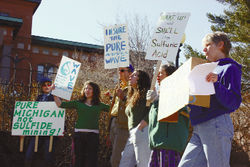
RALLY at the Mine Site Gate: Saturday, July 9, 4:30 pm
Food and Social in Big Bay
Fireworks, 10:30 pm, Squaw BeachOn Saturday, July 9, concerned citizens of Upper Michigan, Northern Wisconsin, and Lower Michigan will launch their ongoing, organized “U.P. Grassroots Campaign to Defend our Water and Stop the Eagle Mine.”

Led by WAVE (Water Action Vital Earth), the action partner of SWUP (Save the Wild U.P), the campaign kicks off with a rally on Saturday, July 9, on the steps of the Marquette County Courthouse at 1:00 pm.

Featured speaker will be Laura Gauger of Wisconsin, author of the book, The Buzzards have Landed. Other speakers include Dr. Alan Olson, addressing the importance of water, Jon Magnuson of the Cedar Tree Institute, and longtime activist Scott Rutherford of Hancock.

Speakers will make the case that the mine poses a clear and present danger to our watersheds of Lake Superior, and to the health of local citizens for generations to come.

WAVE holds that this mine is only the beginning of exploitation, and will lead to water contamination on a scale hitherto unknown in this area.

Following the rally, participants will travel to public lands near Eagle Rock for a time of meditation and reflection, before going to Big Bay for a picnic supper and Big Bay’s annual Fireworks.

The purpose of the campaign is to arouse, inspire, and mobilize our citizens to make a renewed effort to block the mine.  Its specific objective is to convince Governor Snyder to issue an executive order to halt work on the mine and call for a complete third party environmental impact study (EIS) on every aspect of the Eagle Mine project.

WAVE, in March, had appealed to the governor do so because of the grave danger the mine posed to our water resources and our health.   He refused, an action WAVE and SWUP found unconscionable.

Scott Rutherford, 77, a veteran and member of WAVE, is planning an extended, open-ended fast, beginning July 9.

Scott says, “The fast is, in part, an appeal to Governor Snyder to reflect on the moral implications of his refusal to call a halt to work on the mine.”

Campaign planners are working on several events during the summer and fall, including walks on the Yellow Dog Plains, special speakers and workshops, street theatre presentations, fund-raising socials, and an area-wide conference.

Everyone of good heart is welcome to participate in all events, say the members of WAVE and SWUP. Updated information will be continually provided on this website.


Support the U.P. Grassroots Campaign to Defend Our Water and Stop the Eagle Mine

Campaign kick-off: JULY 9!!!

Dear Save the Wild UP supporter,

We are writing to ask you to join and support a new campaign that SWUP (Save the Wild UP) with its partner, WAVE (Water Action Vital Earth), is organizing to halt development of the Kennecott Eagle Mine.  It is called the UP Grassroots Campaign to Defend Our Water and Stop the Eagle Mine. It may well be our last best chance to do so.

The campaign is a joint venture of SWUP and WAVE.  SWUP’s role will be largely administrative, and educational.  It will serve as a clearing house for information about the campaign.  WAVE, a new organization you may not be familiar with, is a collective, formed by members of the coalition opposed to sulfide mining.  It will serve as the political arm of the campaign.  It will be responsible for taking actions needed to accomplish the campaign’s goal and objectives.

We will fast, vigil, pray, do walks and consider other nonviolent means of expressing our distress at the continued development of the mine.  We will support activities at Eagle Rock organized by members of the Keweenaw Bay Indian Community and other tribes.  And we will use the campaign as an opportunity to consider how we will resist new mining projects in the sulfide ore rich western U.P. that Rio Tinto and other mining companies are planning.

The campaign is urgently required.  Kennecott has indicated that it may begin underground construction of the mine as early as mid-September.   It presently plans to blast the mine’s portal directly through Eagle Rock, a sacred site of the Annishinabe people.  It has also become a symbol for all of us of the sacredness our precious, fragile ecosystem.


Please read the attached letter and respond as you feel appropriate2011 0618 FINAL Letter Final with LOGOS


Donations are made easy online via PayPal by clicking the DONATE button on the front page.


Make as generous a donation as you can to support this new, all out effort to stop the Eagle Mine.  Thank you.


Sincerely,


Gail Griffith, President, SWUP


Catherine Parker, WAVE Spokesperson


Penokee Hills Education Project Formed

For Immediate Release June 20, 2011

Contact: Frank K. Koehn:

218.341.8822 (C) 715.682.0635 (O)  715.774.3333 (H)

penokeehillseducationproject@gmail.com

Ashland WI – Citizens from Ashland, Bayfield and Iron Counties concerned about mining developments have formed the Penokee Hills Education Project (PHEP).  PHEP has organized to address the fast-track proposal to begin iron ore (taconite) mining in Northern Wisconsin’s Penokee Hills and Bad River watershed. The Penokee Hills and the Bad River watershed, located in Ashland and Iron Counties, have been targeted for iron ore (taconite) by a subsidiary of Florida-based Cline Group.

Continue reading

Minnesota: June 22nd is Sulfide Mining Awareness Day

Canoe Wild RiceWaterLegacy is collaborating with Friends of the Boundary Waters to promote Sulfide Mining Awareness Day on June 22. 

Talk with your friends, family, and neighbors about the dangers of sulfide mining and help them send a comment on the Hardrock Draft EIS if they haven’t already.

Help make sure our prized northern Minnesota lake district and Lake Superior are protected from toxic pollution and noise caused by prospecting and sulfide mining.

Check WaterLegacy.org or Friends-Bwca.org soon for more details!

Mother Earth “Turtle Island” Water Walk 2011

Poster: WaterWalk11
Mother Earth Water Walkers are walking from four directions, across Turtle island, carrying four copper pails of four salt waters to Bad River, Wisconsin on the shores of Lake Superior, the very beginning place of the Walk that started it all.
Updated schedule:
June 4,5:  Seney
June 6,7:  Harvey
June 7,8:  Champion
Contact Info:  www.motherearthwaterwalk.com or waterwalk2011@gmail.com


Preserving the Great Lakes up to the people

Another opinion
May 29, 2011
The Traverse City Record-Eagle

The history of natural resources is simple. They vanish rapidly when they become commodities – even when they seem in unending supply.

In Michigan, it took less than a century in the 1800s to devastate fish populations of the Great Lakes, cut down primeval forests, shoot millions of passenger pigeons to extinction and annihilate sturgeon.

As millionaire Chicago fish dealer Alfred Booth said in 1885: “It did not take long for capital to see the rewards which might be gained by reaping the fields which Nature had so abundantly supplied with a crop that cost nothing for the sowing or raising, and but little for the reaping.”

Booth was talking about fish but his words apply to any abundant natural resource of the 1800s that was cut down or slaughtered and shipped off to far-away markets.

Fresh water from the Great Lakes apparently has become the region’s last “free” crop to extract, sell and export.

This is what the Great Lakes water fights of the last three decades really are about. It’s an important battle and will have great impact on the region’s future.

It is why governments, municipalities, elected leaders and individuals must become better stewards and more educated about the important role the Great Lakes, with 94,676 square miles of surface water, play in this region’s life, economy and natural world.

It is why fresh water must always be seen, protected and managed as a “public commons” by those who live around it – not international corporations and Wall Street.

Water is a vastly different natural resource than timber, wildlife, minerals and other natural resources. Humans, animals, plants and ecosystems cannot survive without it.

This is why fresh water, lakes, rivers, streams and navigable waters long have been protected by law and regulations for the common good.

To legally identify water from the Great Lakes as a “commodity” sets up a legal framework that would allow it to be siphoned off and sold for use outside the Great Lakes basin.

Current attempts to dismantle state and federal protection laws enacted in the 1960s and 1970s are an outrage given the history of these freshwater seas.

Traverse City has become a center for water advocacy, thanks to conservation lawyer Jim Olson and many Michigan residents. Olson was the attorney in the nine-year case of Michigan Citizens for Water Conservation vs. Nestle Waters of North America in Mecosta County.

He and other water activists who formed Flow for Water are vigilant sentinels for the Great Lakes and have done much to educate the public in annual conferences like “Saving the Great Lakes Forever,” held at the State Theatre and Northwestern Michigan College earlier this month.

“Too many people see the Great Lakes as a big dollar sign,” keynote speaker Maude Barlow said. “This way of looking at nature as a resource for us is failing the Earth.”

She’s right. The history of the Great Lakes’ natural resources proves that.

Sessions like this month’s conference – organized by Flow for Water, the Great Lakes Water Institute at NMC and Michigan Citizens for Water Conservation – keep water issues in public focus.

Without them, people might lose sight of what these great bodies of fresh water mean to Michigan, the United States and the world.

The lakes clearly need strong advocates, stewards and leaders at the grass-roots level all along their shores.

Recent water politics and court decisions show us that the federal and state governments, big business, and the Michigan Supreme Court have little interest in saving Great Lakes water.
© Copyright 2011 The Traverse City Record-Eagle. All rights reserved. This material may not be published, broadcast, rewritten or redistributed.

http://www.miningjournal.net/page/content.detail/id/562863/Preserving-the-Great-Lakes-up-to-the–people.html?nav=5003

What’s the rush on mine permitting?

By Al Gedicks

May 19, 2011  http://www.jsonline.com/news/opinion/122260424.html

Should the state’s regulatory authority over the metallic mine permitting process be dramatically reduced to accommodate the wishes of a mining company to receive a permit in record time? This is not a hypothetical question.

Gogebic Taconite (GTAC) has met with several legislators about its proposed open pit iron ore (taconite) mine along the border of Ashland and Iron counties to push legislation that would drastically speed up the mine permitting process.

The present review process, which was the result of hard-fought environmental battles in the 1970s, can take several years, depending on the complexity of the mine plan and the potential environmental impacts of the project. However, Sen. Rich Zipperer (R-Pewaukee) and state Rep. Mark Honadel (R-South Milwaukee) plan to propose legislation that would reduce the review to 300 days. GTAC President Bill Williams told a reporter that his company may abandon its plans for a $1.5 billion taconite mine and processing plant if the process takes too long.

Ever since a grass-roots Indian and environmental alliance defeated a proposal to build a metallic sulfide mine at Crandon, the international mining industry has considered the state among the least favorable places for mining investment.

In 1998, the state passed the Mining Moratorium Law, which requires that before the state can issue a permit for the mining of sulfide ore bodies, potential miners must provide an example of where a metallic sulfide mine in the United States or Canada has not polluted surface and groundwaters during or after mining. In 2003, the Sokaogon Chippewa and the Forest County Potawatomi tribes bought the Crandon mine property for $16.5 million and ended a 28-year conflict over the mine.

GTAC now wants to turn back the clock on environmental protection and respect for the rights of indigenous peoples. Gogebic Taconite is a limited liability company registered on the Toronto Stock Exchange and owned by the Cline Group, a coal mining company based in Florida. Christopher Cline is a billionaire who owns large coal reserves in Illinois and Northern Appalachia.

If GTAC has its way, local citizens and the Bad River Chippewa tribe, who will be most directly affected by the proposed mine, will have little opportunity to participate in a thorough review of the social, economic and environmental impacts of the project. What information might be disclosed during a mine permit review process that would be so threatening to GTAC?

Bad River Chippewa Chairman Mike Wiggins Jr. is concerned that this mine could discharge polluted water to the Bad River watershed and the tribe’s wild rice beds in the Kakagon Sloughs, a 16,000-acre complex of wetlands, woodlands and sand dune ecosystems that is one of the largest freshwater estuaries in the world.

Wild rice is a sacred plant for the Chippewa and is very sensitive to water contamination as well as fluctuations in water levels. Dewatering operations at the proposed mine could lower the water table around the mine. It was the effort to protect the Sokaogon Chippewa’s wild rice beds that propelled the Crandon mine conflict.

The proposed mine involves extracting taconite by removing about 650 feet of overburden and creating a narrow pit around 4 miles long, up to 900 feet deep and a quarter-mile wide. The overburden would be dumped in massive tailings piles along the northwest side of the Penokee-Gogebic Range and at the headwaters of the Bad River Watershed. These large tailings piles have the potential to generate acid rock drainage if sulfide minerals are present in the waste rock.

These issues need to be evaluated in a fair and open environmental review through which the public and the Lake Superior Chippewa bands have the opportunity to have full disclosure of the potential impacts of the project. Legislation that would reduce the review process to 300 days would severely limit full disclosure of these impacts and be in direct violation of both state environmental law and treaties with the Lake Superior Chippewa bands.

Zipperer has expressed his desire to have the legislation passed before the end of the current session on June 30. Why is this legislation being fast-tracked? If passed, this legislation will effectively exclude Wisconsin citizens and tribes from having a voice in one of the most far reaching environmental decisions facing northern Wisconsin communities.

Al Gedicks teaches sociology at the University of Wisconsin-La Crosse and is author of “Resource Rebels: Native Challenges to Mining and Oil Corporations.”

“New Warriors for the Earth” WEBSITE

http://newwarriorsforearth.wordpress.com/author/newwarriorsforearth/

From Jessica Koski:  2011 0501 Leadership needed

Oshikinawe-Ogichidaag Akiing ‘New Warriors for the Earth’ is an Anishinaabe-based non-profit organization dedicated to educating and empowering our communities to take positive action to protect Aki, Mother Earth. We are grounded and guided by our Anishinaabe heritage and culture.  Our mission is to raise awareness about mining and environmental injustices facing the Western Great Lakes region and Aki. Our initial purpose is to protect our abundant freshwater resources and traditional homelands located in the Upper Peninsula of Michigan from intrusive multinational mining corporations and hazardous sulfide and uranium mining.

Facebook page: http://www.facebook.com/pages/New-Warriors-for-the-Earth/127252830644821?ref=ts

“Saving the Great Lakes Forever” Conference kicks off May 6

To enlarge:   FLOW_legal_4-10-11

(Traverse City, MI) –People from around the entire Great Lake Basin will be gathering for the 2011 Conference “Saving the Great Lakes Forever” which kicks off on Friday, May 6, at 6:50 p.m. at the historic State Theater in downtown Traverse City.

Hosted by the Flow for Water Coalition, the Great Lakes Water Studies Institute at Northwestern Michigan College and Michigan Citizens for Water Conservation, the conference will focus on learning about the abuses and threats facing the Great Lakes.  The conference will also provide solutions to stop these threats and to protect the citizens, communities, local agriculture, and businesses who depend upon the waters of the Great Lakes Basin.

Friday night’s kick-off will feature a presentation by Maude Barlow, internationally recognized water advocate and former Senior Advisor to the President of the United Nations General Assembly.  Ms. Barlow is the author of 16 books.  Her address will offer a unique perspective on how each of us living within the Great Lakes Basin need to come together to protect the waters of the Great Lakes.

A screening of the award winning documentary “Tapped”, an unflinching look at the plastic bottled water industry, will follow Ms. Barlow’s presentation and the evening will conclude with an afterglow party in the “Dome” at the Park Place Hotel for networking, live music, and refreshments.

The conference continues on Saturday, May 7, at Milliken Auditorium and Scholar Hall on the campus of Northwestern Michigan College. Registration opens at 8:00 a.m.  Welcome and introductions begin at 8:45 a.m.

Wenonah Hauter, Executive Director of Food and Water Watch and one of the world’s leading experts on water, energy, food and the environment, will speak at 9:00 a.m.  Her address will be followed by breakout workshop sessions on a variety of water-related hot topics.  The event will conclude with an expert roundtable discussion:  Solutions for Saving the Waters of the Great Lakes Basin.

“We are incredibly excited to hold this conference here and to be able to have presentations from both Maude Barlow and Wenonah Hauter.  They will provide a dynamic wake-up call to everyone interested in protecting our Great Lakes,” said Traverse City attorney, Jim Olson, who also serves as Executive Director of the Flow for Water Coalition.

“We take our incredible natural beauty and abundance for granted, but there are very real threats facing the Great Lakes Basin.” Olson continued, “ If we don’t protect these majestic waters now, the Great Lakes could be lost for our future generations.  Our goal is to build deep citizen awareness and provide solutions to make sure that doesn’t happen.”

Tickets are $25 per person for the 2-day event or $40 for two.

Tickets can be purchased on-line at www.flowforwater.org.

Or you can register, purchase tickets or obtain additional information at Jilliebean Green at (231) 432-0103 or at flow@jilliebeangreen.com

Contact: Jim Olson

231-946-0044

olson@envlaw.com

Brian Beauchamp

231-946-6584

brian@mlui

Terry Swier

231-972-8856

tswier@centurytel.net